Contrada

History
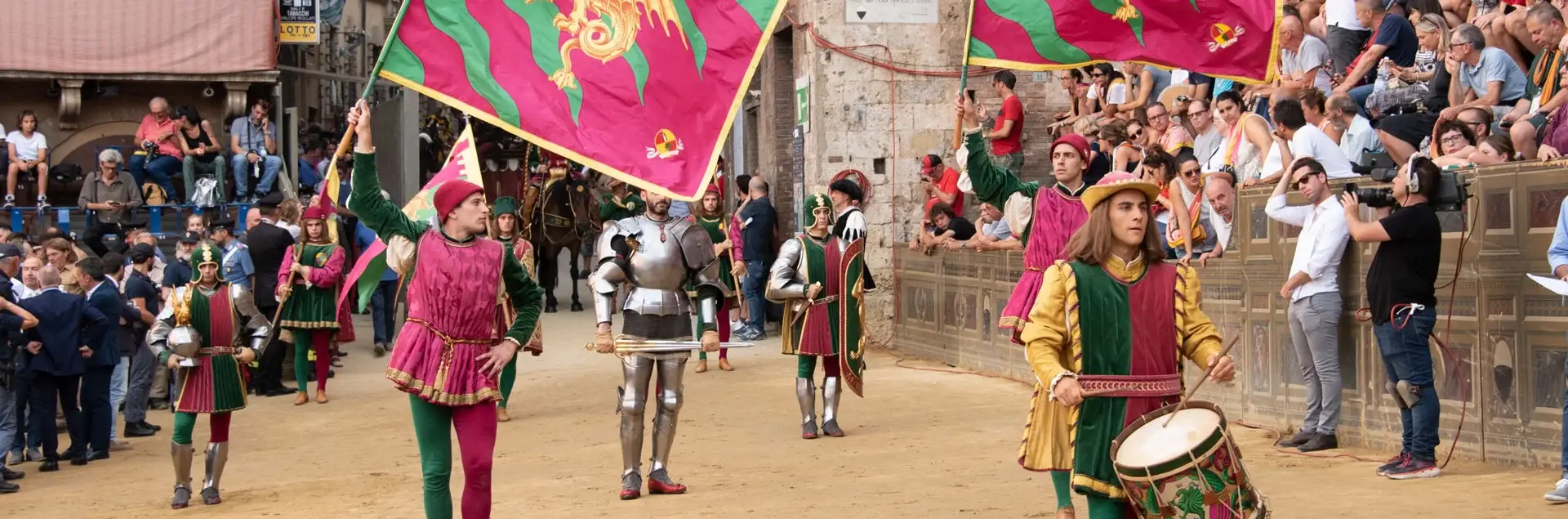
The Contrada del Drago was among the first to appear in public celebrations on the Campo. Along with Giraffa, Chiocciola, and Onda, it participated in a "Pugna," organized in honor of the Cardinal of St. Malò on March 1, 1494. Results from recent research document its existence as early as 1481, and significantly, outside of participation in public events. The Contrada includes the ancient Military Companies of San Donato da’ Montanini and Sant’Egidio del Poggio Malavolti. It probably took its emblem and name from the mythical animal depicted on the crest of the former. Some believe instead that the name and emblem could derive from the Borghesi family's coat of arms: a yellow dragon on a green field, while others think it might have adopted the emblem from the Benincasa family, the family of Saint Catherine, who is also its Patron Saint. In any case, it was with a dragon-shaped machine that the members of this Contrada participated in the first "Bull Hunts" and were called "the men of the Dragon."

Territory
The territory of the Contrada del Drago coincides for two streets with the ancient Via Francigena. These are the right side (towards the Campo) of Via Montanini and Via Banchi di Sopra, up to Via dei Pontani. The other key places of the district are Piazza Matteotti, with the historic seat that includes the Oratory of Santa Caterina del Paradiso, the Sala delle Vittorie, where the Palio banners won by the Contrada are kept, and the Baptismal Fountain by Vico Consorti; Via del Paradiso, once the seat of the Società di Camporegio and today home of the Costume Gallery; and the Basilica of San Domenico, next to the present Società di Camporegio. Other important streets of our Contrada are Via della Sapienza, where the Biblioteca Comunale degli Intronati (the Municipal Library) is located, Via di Camporegio, Via dei Termini, Via delle Terme, Via dei Malavolti, and Via Curtatone. The most characteristic alleys are those of Campaccio, della Rosa, del Cavalletto, and del Rustichetto. The horse's stable is in another alley, called “Vicolo della Palla a Corda”, which opens off the far end of Via della Sapienza and leads into no other street. As reported by the Bando of Violante of Bavaria, which in 1730 by decree established the boundaries of the seventeen Contrade, the territory of the Drago is delineated by the following streets and buildings: From the church of San Domenico in Camporeggi inclusive, follow the road that leads to Sapienza on both sides, descend the slope on both sides until the parish church of Sant'Antonio exclusive, from there turn back onto the aforementioned Via della Sapienza, keep it all, and turning left, climb the alley to the Osteria della Rosa and, keeping to the left, pass under the arch facing Galli in the main street of Camollia, where again keeping to the left go until the turn called Cavallerizza and occupying all the houses on that side, including the Palazzo and Poggio Malavolti, convent and Via del Paradiso, return to Camporeggi and include Via del Pulcino and the road that from Camporeggi through the gardens leads to Lizza.

Headquarters
The present-day Sala delle Vittorie (Victory Hall), created in 1950 from the cellars beneath the Oratory of Santa Caterina del Paradiso, holds the thirty-nine Palii won by the Contrada, together with other memorabilia placed there in recent years. The Palii were previously kept in the Sala Grisaldi Del Taja, today the Sala dei Costumi. Unfortunately, not all the drappelloni have come down to us. We cannot say that they were lost, because in early times the prize for the winner was not, as it is today, a painted silk banner, but a long rectangular length of precious fabric (almost always used afterwards to make sacred vestments) placed on top of a wooden pole, or a silver basin. Some documents allow us, for example, to trace the description of the Palio won by our Contrada on 6 November 1650: “… a Palio of crimson damask with a white frieze and a lining of black and white taffeta, the emblem of our Balzana….”. Moreover, at that time and later, the Contrade that, like the Drago, had no seat of their own entrusted particular objects to the care of their members. The break-up or relocation of families probably caused, over time, the loss of some memorabilia. This explains why objects that once certainly belonged to the Contrade of Siena occasionally turn up on the antiques markets of Italy, such as the late 18th-century flag found in Cortona and reacquired by the Contrada in 1980. Although the Contrada del Drago is so ancient, it only had a seat of its own from 27 October 1787, when the Grand Duke of Tuscany Pietro Leopoldo, moved by the petitions of the contradaioli, generously granted the Drago the Oratory and part of the suppressed convent of the Monache del Paradiso (Nuns of Paradise). The Contrada, however, only took physical possession of it in April 1788. The earliest historical records kept in the Contrada’s Archive date back to 31 July 1786 and were written by the Chancellor of the time, Isidoro Casacchi. The Contrada had no Priore until August 1709; before then it was governed by three Grandi Protettori (Great Protectors). No earlier documents have been found so far; only the books of the Compagnia Laicale di San Domenico (the lay confraternity of San Domenico) occasionally mention our Contrada, from 1649 onwards. The men of the Drago met in private houses or in some workshop in the district until September 1650, when they were allowed to hold their meetings in the chapel of the Brothers of the Compagnia Laicale di San Domenico in Camporegio. From 1679 the Compagnia Laicale di San Domenico even undertook to contribute 10 lire to the expenses of the Palio, on condition that, in the event of victory, the prize be offered as a sign of devotion to the altar of San Domenico. This arrangement lasted until 2 July 1738 when, after winning the Palio, the Captain of the Drago, Simone Contri, refused to hand over the prize, a silver basin, claiming that it belonged exclusively to the people of the district. The matter even ended up in court, where unfortunately the Contrada lost. We also know for certain that the oldest Palio won by the Contrada, that of 1650, was voluntarily handed over by the Dragaioli to the Compagnia Laicale di San Domenico. The same fate befell those of 1682, 1717, 1724, 1729 and, as we have seen, that of 1738, the year in which the collaboration between the Contrada del Drago and the Compagnia Laicale di San Domenico probably ended. In 1748, perhaps on the occasion of the victory in the Palio of 16 August, the Contrada asked for the return of all the prizes kept by the Brothers of the Compagnia, but unfortunately to no avail. This leads us to believe that until that year the Palii still existed and were recognisable. The Palii won in 1748, 1763 and 1771 (probably in the form of painted drappelloni) may have been entrusted to the care of some contradaiolo or, if made of precious fabric, turned into sacred vestments or furnishings. Either way, unfortunately, these have not come down to us either. Who knows: looking at a silver dish or a chasuble in the Sacristy of the Oratory, we might be standing, without knowing it, in front of a Palio. These Palii, however, may also have been handed over to the Compagnia, since in 1739, a year after the disputed victory, the Priore of the Drago complained that the Compagnia Laicale di San Domenico wanted to offer only 8 lire per Palio won, instead of the agreed 10. This suggests that relations of mutual collaboration were not definitively broken off in 1738, but rather continued until the Drago had a seat of its own. These Palii, won but lost to us, are remembered by the nine Paliotti commissioned by our Contrada, which bear witness to the victories won on the Campo. The image of the Madonna distinguishes the July Palii from the August ones. When the drappelloni were moved from the Sala Grisaldi Del Taja to the new Sala delle Vittorie, a mistake was made at one point in arranging them side by side in chronological order. It was caused by a misreading of the wooden label identifying the case. Today’s Palio is nothing more than a painted silk banner, and for a long time, until the end of the 19th century, it was made without any artistic ambition. “… Its value is purely intrinsic, symbolic, ideal. Yet every era has left its mark on the drappelloni, which thus form so many pages of visual history, records of different periods, regimes, occupations …”. In this regard, it is interesting to know that the actual prize generally consisted of a sum of money (60 thalers in July and 40 in August), which was handed to the winning Contrada when it returned the silver basin fixed to the top of the pole, crowning the painted drappellone. The drappellone, which in the meantime had replaced the banner of precious fabric, remained with the Contrada as tangible evidence of the victory, while the money was spent on the most diverse needs. The coats of arms painted on the drappelloni commemorated the Deputati della Festa, who had personally borne the costs of organising the whole celebration. The cash prize survives today in the traditional presentation, by the Mayor to the victorious Contrada, of replicas of the ancient coins on the day of the Festa della Vittoria. A Palio of any era, even kept behind glass, immediately evokes the indescribable emotion of the Carriera and its aftermath: the shouting, the triumph of the flags and the roll of the drums beating for victory, the sweaty embraces and the warm tears of joy. Just as we have lived it and live it today, so our grandparents lived it. Closing your eyes in front of a Palio, you can clearly sense, with your heart, the festive atmosphere, the irrepressible joy and the presence of those who lived it, longed for it and won it. First made by local craftsmen, over time the Palii have been entrusted to increasingly important artists of national and international fame, so much so that today the drappellone, while always keeping its symbolic character, is a true work of art.

La Sedia
“La Sedia”, the governing body of the Contrada, is responsible for the organisation of the Contrada and the administration of its assets and activities. The members of the governing body, in addition to the Priore who presides over it, include: the Vicario, the Provicari, the Conservatore della Legge, the Cancelliere, the Bilanciere, the Camarlengo, the Economo, the Conservatore dell'Archivio, the Provveditore all'Oratorio, the Signore del Brio, the Addetto ai Protettori, the Addetto ai Giovani, the Maestro dei Novizi, the Addetto ai Beni Immobili, the Provveditore alle Finanze, the Conservatore dei Beni Artistici, any other Addetti, the Consiglieri di Sedia and the members of the Collegio dei Maggiorenti (College of Elders). The governing body of the Contrada is elected by the Protettori (ordinary members of the Contrada) and its members remain in office from the date it takes office until the 31st of December of the following year, with the exception of the College of Elders, whose members are part of it by right.

Staff Palio
The Captain, together with the Priore, is one of the most important figures in the Contrada. His role is centered on performance of the Contrada in the Palio, for which he is the main architect, and he is responsible for trying to ensure that the Drago wins. Indeed, given the utmost importance and sensitivity of this assignment, the Captain operates in total autonomy striving to achieve victory in the Palio. In this regard, he personally appoints a Palio Team every year, which he manages during his tenure. The Captain's closest collaborators are the "Mangini" or "Lieutenants," who assist and act on his behalf, their number could vary based on the Captain's needs at the time he takes the office. Currently Jacopo Gotti is the Captain, and his Mangini are Federico Melai, Francesco Mugnaini, Giovanni De Luca, Nicolò Meniconi. The Captain has the authority to appoint the Barbaresco and his deputies, who are responsible for the well-being of the horse during the four days of each Palio. They even sleep with the horse and watch over it 24 hours a day to constantly ensure its well-being. The Stable Staff is completed with the appointment of veterinarians and farriers, who may often be external to the Contrada. The decision to employ experts in the equestrian field, often of national and international renown, stems from the Contrade's desire to constantly protect the horse's health in the interest of the Palio itself. Today the Barbaresco is Tommaso Giuntini, and his deputy is Riccardo Vegni, while the assistants are Tommaso Paccagnini and Sebastiano Gamma. Completing the Palio staff of the Drago are some other important figures, the so-called Guardia-Fantino. They are the "guardian angels" who must ensure the tranquility and physical (and moral) well being of the chosen jockey. The Guardia-Fantino are Giovanni De Luca, Gianluca Cetoloni, Niccolò Bacarelli, Vittorio Tognazzi.