
Headquarters
The present-day Sala delle Vittorie (Victory Hall), created in 1950 from the cellars beneath the Oratory of Santa Caterina del Paradiso, holds the thirty-nine Palii won by the Contrada, together with other memorabilia placed there in recent years. The Palii were previously kept in the Sala Grisaldi Del Taja, today the Sala dei Costumi. Unfortunately, not all the drappelloni have come down to us. We cannot say that they were lost, because in early times the prize for the winner was not, as it is today, a painted silk banner, but a long rectangular length of precious fabric (almost always used afterwards to make sacred vestments) placed on top of a wooden pole, or a silver basin. Some documents allow us, for example, to trace the description of the Palio won by our Contrada on 6 November 1650: “… a Palio of crimson damask with a white frieze and a lining of black and white taffeta, the emblem of our Balzana….”. Moreover, at that time and later, the Contrade that, like the Drago, had no seat of their own entrusted particular objects to the care of their members. The break-up or relocation of families probably caused, over time, the loss of some memorabilia. This explains why objects that once certainly belonged to the Contrade of Siena occasionally turn up on the antiques markets of Italy, such as the late 18th-century flag found in Cortona and reacquired by the Contrada in 1980.
Although the Contrada del Drago is so ancient, it only had a seat of its own from 27 October 1787, when the Grand Duke of Tuscany Pietro Leopoldo, moved by the petitions of the contradaioli, generously granted the Drago the Oratory and part of the suppressed convent of the Monache del Paradiso (Nuns of Paradise). The Contrada, however, only took physical possession of it in April 1788. The earliest historical records kept in the Contrada’s Archive date back to 31 July 1786 and were written by the Chancellor of the time, Isidoro Casacchi.
The Contrada had no Priore until August 1709; before then it was governed by three Grandi Protettori (Great Protectors). No earlier documents have been found so far; only the books of the Compagnia Laicale di San Domenico (the lay confraternity of San Domenico) occasionally mention our Contrada, from 1649 onwards. The men of the Drago met in private houses or in some workshop in the district until September 1650, when they were allowed to hold their meetings in the chapel of the Brothers of the Compagnia Laicale di San Domenico in Camporegio. From 1679 the Compagnia Laicale di San Domenico even undertook to contribute 10 lire to the expenses of the Palio, on condition that, in the event of victory, the prize be offered as a sign of devotion to the altar of San Domenico. This arrangement lasted until 2 July 1738 when, after winning the Palio, the Captain of the Drago, Simone Contri, refused to hand over the prize, a silver basin, claiming that it belonged exclusively to the people of the district. The matter even ended up in court, where unfortunately the Contrada lost. We also know for certain that the oldest Palio won by the Contrada, that of 1650, was voluntarily handed over by the Dragaioli to the Compagnia Laicale di San Domenico. The same fate befell those of 1682, 1717, 1724, 1729 and, as we have seen, that of 1738, the year in which the collaboration between the Contrada del Drago and the Compagnia Laicale di San Domenico probably ended. In 1748, perhaps on the occasion of the victory in the Palio of 16 August, the Contrada asked for the return of all the prizes kept by the Brothers of the Compagnia, but unfortunately to no avail. This leads us to believe that until that year the Palii still existed and were recognisable.
The Palii won in 1748, 1763 and 1771 (probably in the form of painted drappelloni) may have been entrusted to the care of some contradaiolo or, if made of precious fabric, turned into sacred vestments or furnishings. Either way, unfortunately, these have not come down to us either. Who knows: looking at a silver dish or a chasuble in the Sacristy of the Oratory, we might be standing, without knowing it, in front of a Palio. These Palii, however, may also have been handed over to the Compagnia, since in 1739, a year after the disputed victory, the Priore of the Drago complained that the Compagnia Laicale di San Domenico wanted to offer only 8 lire per Palio won, instead of the agreed 10. This suggests that relations of mutual collaboration were not definitively broken off in 1738, but rather continued until the Drago had a seat of its own.
These Palii, won but lost to us, are remembered by the nine Paliotti commissioned by our Contrada, which bear witness to the victories won on the Campo. The image of the Madonna distinguishes the July Palii from the August ones. When the drappelloni were moved from the Sala Grisaldi Del Taja to the new Sala delle Vittorie, a mistake was made at one point in arranging them side by side in chronological order. It was caused by a misreading of the wooden label identifying the case.
Today’s Palio is nothing more than a painted silk banner, and for a long time, until the end of the 19th century, it was made without any artistic ambition. “… Its value is purely intrinsic, symbolic, ideal. Yet every era has left its mark on the drappelloni, which thus form so many pages of visual history, records of different periods, regimes, occupations …”. In this regard, it is interesting to know that the actual prize generally consisted of a sum of money (60 thalers in July and 40 in August), which was handed to the winning Contrada when it returned the silver basin fixed to the top of the pole, crowning the painted drappellone. The drappellone, which in the meantime had replaced the banner of precious fabric, remained with the Contrada as tangible evidence of the victory, while the money was spent on the most diverse needs. The coats of arms painted on the drappelloni commemorated the Deputati della Festa, who had personally borne the costs of organising the whole celebration. The cash prize survives today in the traditional presentation, by the Mayor to the victorious Contrada, of replicas of the ancient coins on the day of the Festa della Vittoria.
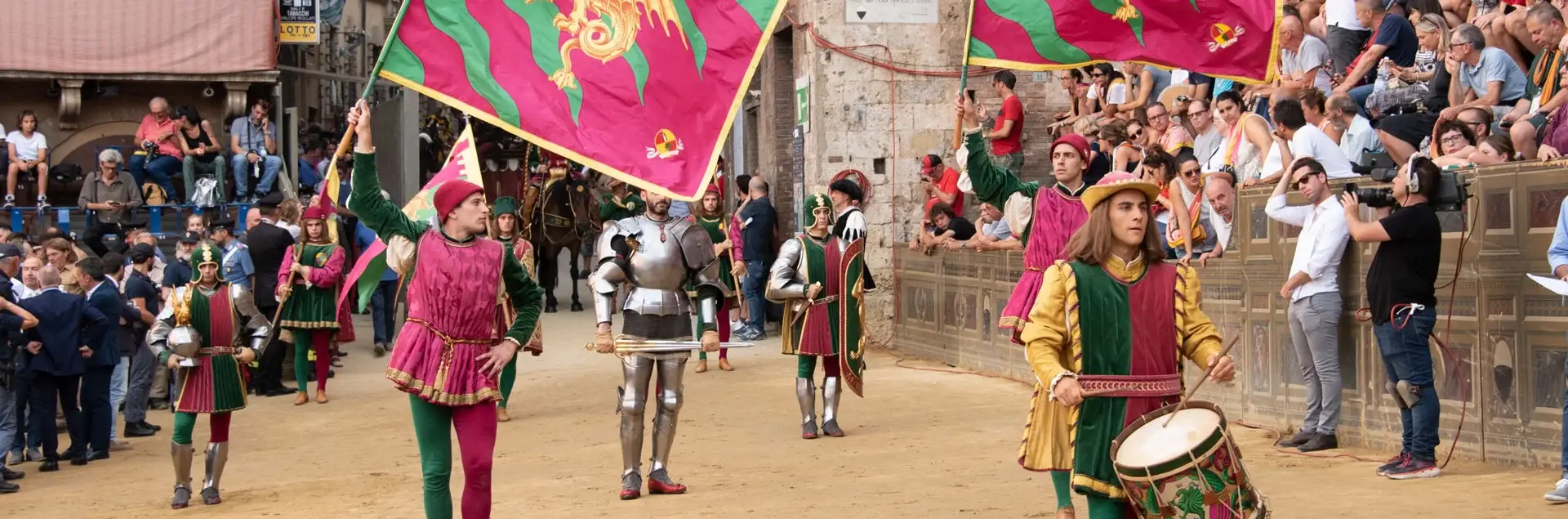
A Palio of any era, even kept behind glass, immediately evokes the indescribable emotion of the Carriera and its aftermath: the shouting, the triumph of the flags and the roll of the drums beating for victory, the sweaty embraces and the warm tears of joy. Just as we have lived it and live it today, so our grandparents lived it. Closing your eyes in front of a Palio, you can clearly sense, with your heart, the festive atmosphere, the irrepressible joy and the presence of those who lived it, longed for it and won it.
First made by local craftsmen, over time the Palii have been entrusted to increasingly important artists of national and international fame, so much so that today the drappellone, while always keeping its symbolic character, is a true work of art.